
Shaders
pz.shader is a widget painted on the GPU by a function you write in
WGSL, the shading language of WebGPU. The GPU runs it for every
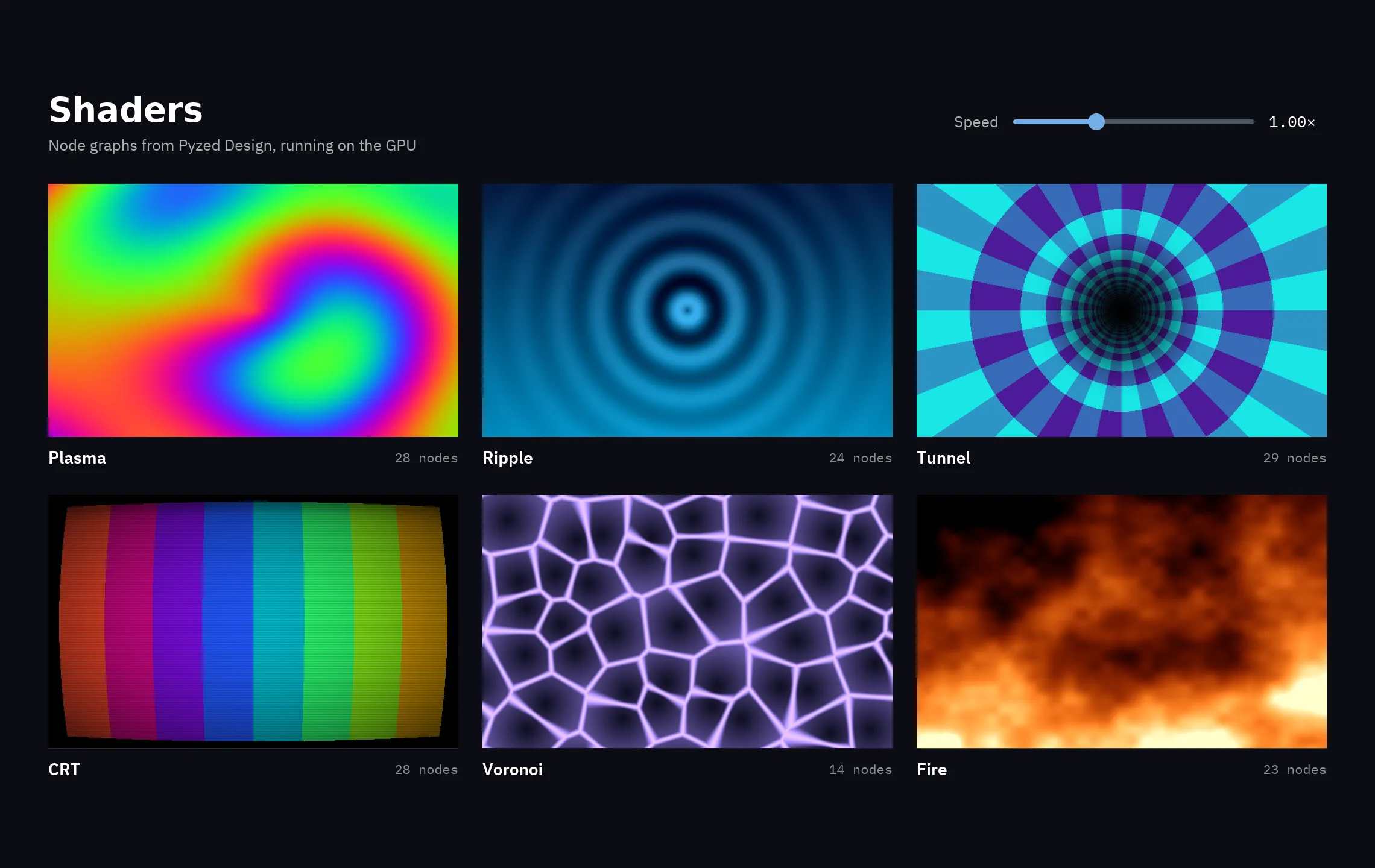
pixel, every frame, so animated backgrounds, plasma, fire or a radar sweep cost Python nothing.
WAVES = """fn shade(uv: vec2<f32>, px: vec2<f32>, size: vec2<f32>, time: f32) -> vec4<f32> {    let wave = 0.5 + 0.5 * sin(uv.x * 12.0 + time * speed());    return vec4<f32>(mix(vec3<f32>(0.1, 0.1, 0.3), tint().rgb, wave), 1.0);}"""
pz.shader(WAVES, uniforms={"speed": 2.0, "tint": "accent"}, height=200)
The shade function
Section titled “The shade function”Your code defines shade, plus any helper functions it needs. It gets:
| Argument | Meaning |
|---|---|
uv |
Where the pixel is, from (0, 0) at the top left to (1, 1) at the bottom right. |
px |
The same position in pixels. |
size |
The widget’s size in pixels. |
time |
Seconds since the app started. |
It returns the pixel’s color as vec4<f32>(red, green, blue, alpha), each from 0 to 1, in the
same color space as CSS colors. mouse() returns the pointer position as a uv (negative when
the pointer is outside the widget); a shader that calls it redraws when the mouse moves.
Uniforms
Section titled “Uniforms”uniforms passes up to 32 values from Python. Each becomes a function with its name:
| Value | WGSL |
|---|---|
| A number | speed() returns f32 |
| 2, 3 or 4 numbers | vec2<f32>, vec3<f32> or vec4<f32> |
| A color (hex or theme token) | vec4<f32> with the color’s red, green, blue and alpha |
Change the values in view() like any other property: the shader is compiled once and only the
values change, so a slider can drive it at full frame rate.
Options
Section titled “Options”width,height: the size ("fill"by default).animate=Falsedraws a still picture that only changes when the view does.time=1.5freezestimeat that value.fallbackis a color or gradient drawn where there is no GPU (and behind the shader where it is transparent).textures={"photo": "assets/photo.png"}passes up to 8 images: each becomes a function,photo(uv), that returns the image’s color atuv(it repeats outside 0..1).
Errors
Section titled “Errors”The code is checked when the widget is created, so a mistake raises a ValueError in Python
with the compiler’s message and the line:
ValueError: invalid shader:error: no definition in scope for identifier: `colr` ┌─ wgsl:24:12Combining with other effects
Section titled “Combining with other effects”A shader is a widget, so it works with the rest of Pyzed: put it in a pz.stack behind glass
panels (they blur it), clip it with a container, rotate or fade it with style() and
animate(). The showcase demos use shaders for a space nebula, a synthwave
horizon, drifting embers and moving color blobs.
Limits
Section titled “Limits”- Shaders need the GPU renderer. On the software renderer (no GPU, and some CI machines) the
widget shows
fallback; screenshots taken there show it too. Without a real GPU, Pyzed picks the software renderer; start the app withICED_BACKEND=wgputo run shaders on an emulated GPU instead (on Linux, Mesa’s software Vulkan driver,mesa-vulkan-drivers). - The corners of a shader are square:
radiuson a container around it does not round them.