
SQLAlchemy
SQLAlchemy runs in the same process as the window (architecture 1 in Architectures). There are two demos:
sqlalchemy_quickstart: theUserandAddressmodels of SQLAlchemy’s ORM Quick Start, with the same window on a syncSessionor on the asyncio extension.sqlalchemy_contacts: 20,000 rows in a virtual table, with search and sorting in SQL.
The Quick Start in a window
Section titled “The Quick Start in a window”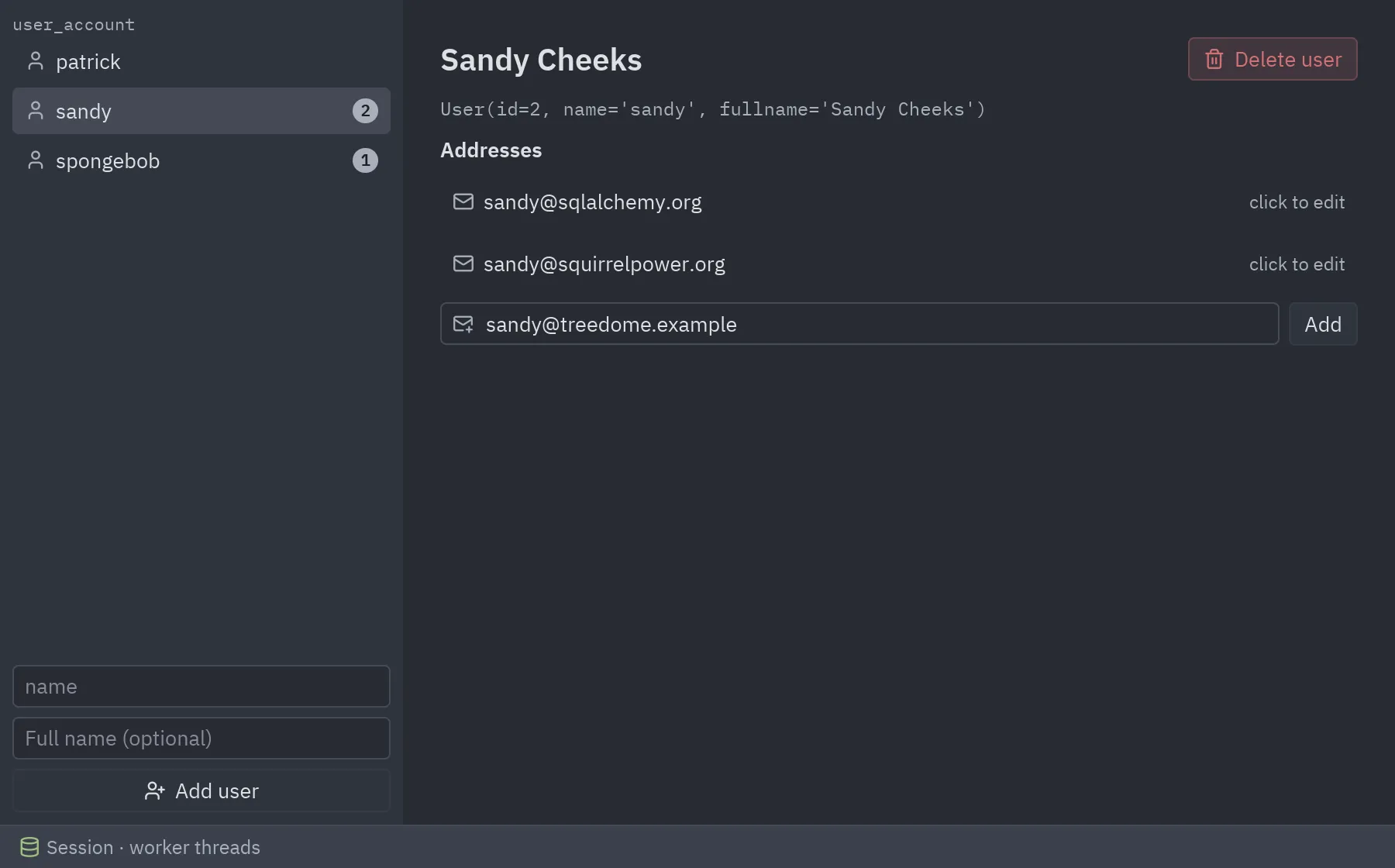
cd examples/integrations/sqlalchemy_quickstartuv run main.py # Session in worker threadsuv run main.py --async # AsyncSession with aiosqlite on Pyzed's loopcd examples/integrations/sqlalchemy_quickstartpython3 -m venv .venvsource .venv/bin/activatepip install pyzed-ui "sqlalchemy[asyncio]" aiosqlitepython main.py # Session in worker threadspython main.py --async # AsyncSession with aiosqlite on Pyzed's loopcd examples/integrations/sqlalchemy_quickstartpy -m venv .venv.venv\Scripts\Activate.ps1pip install pyzed-ui "sqlalchemy[asyncio]" aiosqlitepython main.py # Session in worker threadspython main.py --async # AsyncSession with aiosqlite on Pyzed's loopcd examples/integrations/sqlalchemy_quickstartpython3 -m pip install pyzed-ui "sqlalchemy[asyncio]" aiosqlitepython3 main.py # Session in worker threadspython3 main.py --async # AsyncSession with aiosqlite on Pyzed's loopcd examples/integrations/sqlalchemy_quickstartpy -m pip install pyzed-ui "sqlalchemy[asyncio]" aiosqlitepy main.py # Session in worker threadspy main.py --async # AsyncSession with aiosqlite on Pyzed's loop-
Declare the models exactly as the Quick Start does, with
DeclarativeBase,Mappedandrelationship. The cascade deletes a user’s addresses with the user:class Base(DeclarativeBase):passclass User(Base):__tablename__ = "user_account"id: Mapped[int] = mapped_column(primary_key=True)name: Mapped[str] = mapped_column(String(30))fullname: Mapped[Optional[str]]addresses: Mapped[List["Address"]] = relationship(back_populates="user", cascade="all, delete-orphan")class Address(Base):__tablename__ = "address"id: Mapped[int] = mapped_column(primary_key=True)email_address: Mapped[str]user_id: Mapped[int] = mapped_column(ForeignKey("user_account.id"))user: Mapped["User"] = relationship(back_populates="addresses") -
Create an Engine and the tables:
engine = create_engine("sqlite:///quickstart.db")Base.metadata.create_all(engine) -
Open a Session per unit of work. Each backend function opens its own
Session, which makes it safe to run in any worker thread.selectinloadloads the addresses before the session closes, so the window can readuser.addresseslater:def users() -> list[User]:stmt = select(User).options(selectinload(User.addresses)).order_by(User.name)with Session(engine) as session:return list(session.scalars(stmt))def add_address(user_id: int, email_address: str) -> None:with Session(engine) as session:user = session.get(User, user_id)user.addresses.append(Address(email_address=email_address))session.commit() -
Call it from the window with
Command.perform. The function runs in a thread andthenreceives the result on the UI thread:def on_start(self):return Command.perform(backend.setup, lambda _: self.reload())def reload(self):return Command.perform(backend.users, self.loaded)def add_address(self, *_):user_id, email = self.selected_id, self.new_email.strip()return Command.perform(lambda: backend.add_address(user_id, email), lambda _: self.reload())
The asyncio version
Section titled “The asyncio version”async_backend.py has the same functions written with create_async_engine, an
async_sessionmaker and the aiosqlite driver. Command.perform sees that they are coroutine
functions and runs them on Pyzed’s asyncio loop instead of a thread, so main.py doesn’t change:
engine = create_async_engine("sqlite+aiosqlite:///quickstart.db")async_session = async_sessionmaker(engine, expire_on_commit=False)
async def setup() -> None:    async with engine.begin() as conn:        await conn.run_sync(Base.metadata.create_all)
async def users() -> list[User]: stmt = select(User).options(selectinload(User.addresses)).order_by(User.name) async with async_session() as session: return list(await session.scalars(stmt))Session |
AsyncSession |
|
|---|---|---|
| Where it runs | A worker thread per call | Pyzed’s asyncio loop |
| Pyzed call | Command.perform(sync_function, then) |
Command.perform(async_function, then) or return the coroutine |
| Use it when | Most desktop apps; any driver | You already use asyncio drivers (asyncpg, aiosqlite) |
"""SQLAlchemy's ORM Quick Start in a Pyzed window: users and their email addresses.
    uv run main.py            # sync Session, run in worker threads (sync_backend.py)    uv run main.py --async    # AsyncSession on Pyzed's asyncio loop (async_backend.py)
Both backends have the same functions and the window doesn't care which one it gets:Command.perform runs a regular function in a thread and a coroutine on the loop.Walkthrough: https://albakore.github.io/pyzed/integrations/sqlalchemy/"""
from __future__ import annotations
import sys
import pyzed as pzfrom pyzed import Command, ui
if "--async" in sys.argv:    import async_backend as backendelse:    import sync_backend as backend

class Quickstart(pz.App):    title = "Users · SQLAlchemy"    size = (900, 560)
    def __init__(self):        self.users = []        self.selected_id: int | None = None        self.new_user = {"name": "", "fullname": ""}        self.new_email = ""        self.editing: tuple[int, str] | None = None  # (address id, text being typed)        self.errors: dict[str, str] = {}
    # -- database ----------------------------------------------------------------------------    def on_start(self):        return Command.perform(backend.setup, lambda _: self.reload())
    def reload(self):        return Command.perform(backend.users, self.loaded)
    def loaded(self, users):        self.users = users        if self.selected_id not in {u.id for u in users}:            self.selected_id = users[0].id if users else None
    def run(self, work):        """Runs a backend call, then reloads. ``work`` is a lambda, so its arguments are read now."""        return Command.perform(work, lambda _: self.reload())
    # -- actions -------------------------------------------------------------------------------    def add_user(self, *_):        name, fullname = self.new_user["name"].strip(), self.new_user["fullname"].strip()        self.errors = {"name": "Required"} if not name else {"name": "30 characters at most"} if len(name) > 30 else {}        if self.errors:            return None        self.new_user = {"name": "", "fullname": ""}        return self.run(lambda: backend.add_user(name, fullname))
    def add_address(self, *_):        email, self.new_email = self.new_email.strip(), ""        user_id = self.selected_id        return self.run(lambda: backend.add_address(user_id, email)) if "@" in email else None
    def save_address(self, *_):        address_id, email = self.editing        self.editing = None        return self.run(lambda: backend.rename_address(address_id, email.strip()))
    def delete_user(self):        user_id = self.selected_id        return self.run(lambda: backend.delete_user(user_id))
    # -- view ----------------------------------------------------------------------------------    def sidebar(self, t):        rows = [ui.list_item(u.name, lambda u=u: setattr(self, "selected_id", u.id), icon="user",                             end=ui.count_badge(len(u.addresses), tint="text_muted") if u.addresses else None,                             selected=u.id == self.selected_id, inset=True, height=30) for u in self.users]        form = pz.column([            ui.input(self.new_user["name"], lambda v: self.new_user.__setitem__("name", v), placeholder="name",                     on_submit=self.add_user),            ui.label(self.errors["name"], size="sm", color="error") if self.errors.get("name") else None,            ui.input(self.new_user["fullname"], lambda v: self.new_user.__setitem__("fullname", v),                     placeholder="Full name (optional)", on_submit=self.add_user),            ui.button("Add user", self.add_user, icon="user-plus", full_width=True),        ], spacing=6)        return pz.container(pz.column([ui.muted("user_account", size="xs", mono=True), *rows, pz.vspace(), form],                                      spacing=2), padding=8, width=260, height="fill", bg=t.panel)
    def address_row(self, address):        if self.editing and self.editing[0] == address.id:            return pz.row([                ui.input(self.editing[1], lambda v: setattr(self, "editing", (address.id, v)), on_submit=self.save_address),                ui.icon_button("check", self.save_address, tooltip="Save"),            ], spacing=6, align="center")        return ui.list_item(address.email_address, lambda: setattr(self, "editing", (address.id, address.email_address)),                            icon="mail", end=ui.muted("click to edit", size="sm"), inset=True, height=30)
    def detail(self):        user = next((u for u in self.users if u.id == self.selected_id), None)        if user is None:            return ui.empty_state("No users", "Add one on the left.", icon="users")        return pz.column([            pz.row([ui.heading(user.fullname or user.name, level=2), pz.hspace(),                    ui.button("Delete user", self.delete_user, icon="trash-2", variant="ghost", tint="error")],                   align="center"),            ui.muted(repr(user), mono=True, size="sm"),            ui.label("Addresses", weight="semibold"),            *[self.address_row(a) for a in user.addresses],            pz.row([ui.input(self.new_email, lambda v: setattr(self, "new_email", v), placeholder="new@sqlalchemy.org",                             icon="mail-plus", on_submit=self.add_address),                    ui.button("Add", self.add_address)], spacing=6),        ], spacing=10, padding=24)
    def view(self):        t = self.resolved_theme()        mode = "AsyncSession · aiosqlite" if backend.__name__ == "async_backend" else "Session · worker threads"        return pz.column([            pz.row([self.sidebar(t), pz.container(self.detail(), width="fill", height="fill", bg=t.editor)]),            ui.status_bar([ui.status_item(mode, icon="database", icon_color="success")]),        ])

if __name__ == "__main__":    pz.run(Quickstart)
"""The models of SQLAlchemy's ORM Quick Start: https://docs.sqlalchemy.org/en/20/orm/quickstart.html"""
from typing import List, Optional
from sqlalchemy import ForeignKey, Stringfrom sqlalchemy.orm import DeclarativeBase, Mapped, mapped_column, relationship
class Base(DeclarativeBase): pass
class User(Base): __tablename__ = "user_account"
id: Mapped[int] = mapped_column(primary_key=True) name: Mapped[str] = mapped_column(String(30)) fullname: Mapped[Optional[str]]
addresses: Mapped[List["Address"]] = relationship(back_populates="user", cascade="all, delete-orphan")
def __repr__(self) -> str: return f"User(id={self.id!r}, name={self.name!r}, fullname={self.fullname!r})"
class Address(Base): __tablename__ = "address"
id: Mapped[int] = mapped_column(primary_key=True) email_address: Mapped[str] user_id: Mapped[int] = mapped_column(ForeignKey("user_account.id"))
user: Mapped["User"] = relationship(back_populates="addresses")
def __repr__(self) -> str: return f"Address(id={self.id!r}, email_address={self.email_address!r})"
def sample_users() -> list[User]: """The users the Quick Start creates.""" return [ User(name="spongebob", fullname="Spongebob Squarepants", addresses=[Address(email_address="spongebob@sqlalchemy.org")]), User(name="sandy", fullname="Sandy Cheeks", addresses=[Address(email_address="sandy@sqlalchemy.org"), Address(email_address="sandy@squirrelpower.org")]), User(name="patrick", fullname="Patrick Star"), ]"""The database code, as the Quick Start writes it: an Engine, a Session per unit of work, select().
Each function opens its own Session, so Pyzed can run it in a worker thread (Command.perform)."""
from sqlalchemy import create_engine, selectfrom sqlalchemy.orm import Session, selectinload
from models import Address, Base, User, sample_users
engine = create_engine("sqlite:///quickstart.db")
def setup() -> None: Base.metadata.create_all(engine) with Session(engine) as session: if session.scalars(select(User)).first() is None: session.add_all(sample_users()) session.commit()
def users() -> list[User]: # selectinload fetches the addresses now, so the window can read them after the session closes. stmt = select(User).options(selectinload(User.addresses)).order_by(User.name) with Session(engine) as session: return list(session.scalars(stmt))
def add_user(name: str, fullname: str) -> None: with Session(engine) as session: session.add(User(name=name, fullname=fullname or None)) session.commit()
def add_address(user_id: int, email_address: str) -> None: with Session(engine) as session: user = session.get(User, user_id) user.addresses.append(Address(email_address=email_address)) session.commit()
def rename_address(address_id: int, email_address: str) -> None: with Session(engine) as session: session.get(Address, address_id).email_address = email_address session.commit()
def delete_user(user_id: int) -> None: with Session(engine) as session: session.delete(session.get(User, user_id)) # cascade="all, delete-orphan" removes the addresses session.commit()"""The same database code with SQLAlchemy's asyncio extension and the aiosqlite driver.
https://docs.sqlalchemy.org/en/20/orm/extensions/asyncio.htmlThe functions are coroutines: Pyzed runs them on its asyncio loop, where the engine lives."""
from sqlalchemy import selectfrom sqlalchemy.ext.asyncio import async_sessionmaker, create_async_enginefrom sqlalchemy.orm import selectinload
from models import Address, Base, User, sample_users
engine = create_async_engine("sqlite+aiosqlite:///quickstart.db")async_session = async_sessionmaker(engine, expire_on_commit=False)
async def setup() -> None: async with engine.begin() as conn: await conn.run_sync(Base.metadata.create_all) async with async_session() as session: if (await session.scalars(select(User))).first() is None: session.add_all(sample_users()) await session.commit()
async def users() -> list[User]: # Lazy loading needs an await, so load relationships eagerly with selectinload. stmt = select(User).options(selectinload(User.addresses)).order_by(User.name) async with async_session() as session: return list(await session.scalars(stmt))
async def add_user(name: str, fullname: str) -> None: async with async_session() as session: session.add(User(name=name, fullname=fullname or None)) await session.commit()
async def add_address(user_id: int, email_address: str) -> None: async with async_session() as session: session.add(Address(user_id=user_id, email_address=email_address)) await session.commit()
async def rename_address(address_id: int, email_address: str) -> None: async with async_session() as session: address = await session.get(Address, address_id) address.email_address = email_address await session.commit()
async def delete_user(user_id: int) -> None: async with async_session() as session: user = await session.get(User, user_id, options=[selectinload(User.addresses)]) await session.delete(user) await session.commit()Many rows: the contacts demo
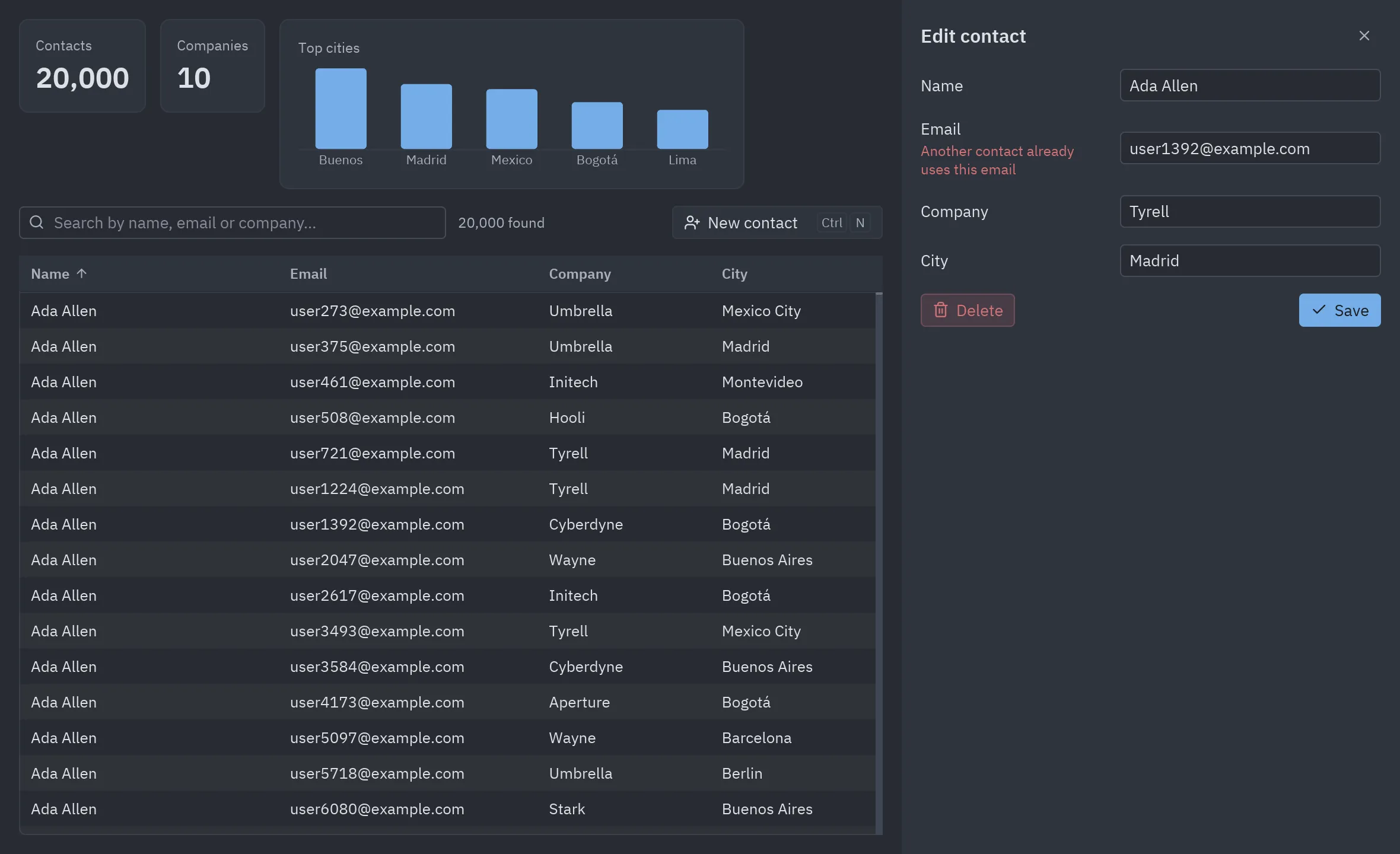
Section titled “Many rows: the contacts demo”A contacts manager on SQLAlchemy 2.0 and SQLite. The table holds 20,000 rows and scrolls
smoothly because ui.table only builds the rows in view; search and sorting run in SQL, in a
worker thread, so the window never waits for the database.
cd examples/integrations/sqlalchemy_contactsuv run main.pycd examples/integrations/sqlalchemy_contactspython3 -m venv .venvsource .venv/bin/activatepip install pyzed-ui sqlalchemypython main.pycd examples/integrations/sqlalchemy_contactspy -m venv .venv.venv\Scripts\Activate.ps1pip install pyzed-ui sqlalchemypython main.pycd examples/integrations/sqlalchemy_contactspython3 -m pip install pyzed-ui sqlalchemypython3 main.pycd examples/integrations/sqlalchemy_contactspy -m pip install pyzed-ui sqlalchemypy main.pyThe demo keeps the database code in db.py, with no Pyzed in it, and the window in main.py.
That split is worth copying: the same db.py could serve a FastAPI app or a CLI.
-
Models are plain SQLAlchemy 2.0.
class Contact(Base):__tablename__ = "contacts"id: Mapped[int] = mapped_column(primary_key=True)name: Mapped[str] = mapped_column(String(80), index=True)email: Mapped[str] = mapped_column(String(120), unique=True)company: Mapped[str] = mapped_column(String(80), default="")city: Mapped[str] = mapped_column(String(60), default="") -
Each query is a function with its own session. SQLAlchemy sessions are not shared between threads, so every function opens one and closes it. The loaded objects keep their values after the session closes, which is all the view needs:
def search(text, sort, descending):column = COLUMNS[sort]query = select(Contact).order_by(column.desc() if descending else column, Contact.id)if text:pattern = f"%{text}%"query = query.where(or_(Contact.name.ilike(pattern), Contact.email.ilike(pattern),Contact.company.ilike(pattern)))with Session(engine) as session:return list(session.scalars(query)) -
Run it with
Command.perform. The function runs in a thread andthengets the result on the UI thread. Returning a list of commands runs them together:def reload(self):query, sort, descending = self.query, self.sort, self.descendingreturn [Command.perform(lambda: db.search(query, sort, descending), lambda rows: self.loaded(query, rows)),Command.perform(db.stats, lambda stats: setattr(self, "stats", stats)),]def loaded(self, query, rows):if query == self.query: # a newer search is on its way: keep waiting for itself.rows, self.loading = rows, FalseCopy the state you need into locals first (
query, sort, ...): the lambda runs later, in another thread, and should not readselfwhile the user keeps typing. -
Hand all the rows to
ui.table. It is virtualized, so 20,000 rows cost the same as 20. Clicking a header callson_sort, which here re-runs the query with a newORDER BY:ui.table(columns, self.rows, sort_by=self.sort, descending=self.descending, on_sort=self.sort_by,on_row_press=self.open, selected=self.editing, striped=True, height="fill") -
Turn database errors into field errors.
savereturns either the contact or{field: message}. A unique constraint becomes a message under the Email field:try:session.commit()except IntegrityError:return {"email": "Another contact already uses this email"}ui.field("Email", ui.input(self.draft["email"], ...), error=self.errors.get("email"))
"""A contacts manager on SQLAlchemy 2.0: 20,000 rows in a virtual table, searched and sorted in SQL.
uv run main.py
The database (contacts.db) is created next to this file on the first run.Walkthrough: https://albakore.github.io/pyzed/integrations/sqlalchemy/"""
from __future__ import annotations
import pyzed as pzfrom pyzed import Command, ui
import db
FIELDS = [("name", "Name", "Ada Lovelace"), ("email", "Email", "ada@example.com"), ("company", "Company", "Analytical Engines"), ("city", "City", "London")]
class Contacts(pz.App): title = "Contacts · SQLAlchemy" size = (1180, 720)
def __init__(self): self.rows: list[db.Contact] = [] self.stats = {"total": 0, "companies": 0, "cities": []} self.query = "" self.sort, self.descending = "Name", False self.loading = True self.editing = None # a Contact, "new" or None self.draft: dict[str, str] = {} self.errors: dict[str, str] = {}
# -- database work runs in a thread with Command.perform ------------------------------ def on_start(self): return Command.perform(db.setup, lambda _: self.reload())
def reload(self): self.loading = True query, sort, descending = self.query, self.sort, self.descending return [ Command.perform(lambda: db.search(query, sort, descending), lambda rows: self.loaded(query, rows)), Command.perform(db.stats, lambda stats: setattr(self, "stats", stats)), ]
def loaded(self, query: str, rows: list[db.Contact]): if query == self.query: # a newer search is on its way: keep waiting for it self.rows, self.loading = rows, False
def search(self, text: str): self.query = text return self.reload()
def sort_by(self, title: str): self.descending = not self.descending if title == self.sort else False self.sort = title return self.reload()
# -- the edit panel ------------------------------------------------------------------ def open(self, contact): self.editing, self.errors = contact, {} self.draft = {key: "" if contact == "new" else getattr(contact, key) for key, _, _ in FIELDS}
def save(self): contact_id = None if self.editing == "new" else self.editing.id values = dict(self.draft) return Command.perform(lambda: db.save(contact_id, values), self.saved)
def saved(self, result): if isinstance(result, dict): self.errors = result return None self.editing = None return self.reload()
def delete(self): contact_id = self.editing.id self.editing = None return Command.perform(lambda: db.delete(contact_id), lambda _: self.reload())
def on_key(self, combo): if combo == "escape": self.editing = None elif combo == "ctrl-n": self.open("new")
# -- view ---------------------------------------------------------------------------- def header(self): cities = self.stats["cities"] return pz.row([ ui.stat("Contacts", f"{self.stats['total']:,}"), ui.stat("Companies", self.stats["companies"]), ui.card(pz.column([ui.muted("Top cities", size="sm"), ui.bar_chart([count for _, count in cities], labels=[c.split()[0] for c, _ in cities], width=360, height=90)], spacing=6)), ], spacing=12)
def panel(self, t): if self.editing is None: return None rows = [ui.field(title, ui.input(self.draft[key], lambda v, k=key: self.draft.__setitem__(k, v), placeholder=hint, width=220), error=self.errors.get(key)) for key, title, hint in FIELDS] new = self.editing == "new" return pz.container( pz.column([ pz.row([ui.heading("New contact" if new else "Edit contact", level=3), pz.hspace(), ui.icon_button("x", lambda: setattr(self, "editing", None), tooltip="Close (Esc)")], align="center"), *rows, pz.row([None if new else ui.button("Delete", self.delete, icon="trash-2", variant="ghost", tint="error"), pz.hspace(), ui.button("Save", self.save, icon="check", variant="solid")], spacing=8), ], spacing=14), padding=16, width=420, height="fill", bg=t.panel, )
def view(self): t = self.resolved_theme() columns = [ ui.Column("Name", "name", width="fill:3"), ui.Column("Email", "email", width="fill:3"), ui.Column("Company", "company", width="fill:2"), ui.Column("City", "city", width="fill:2"), ] toolbar = pz.row([ ui.search_input(self.query, self.search, placeholder="Search by name, email or company…", width=360), ui.spinner() if self.loading else ui.muted(f"{len(self.rows):,} found", size="sm"), pz.hspace(), ui.button("New contact", lambda: self.open("new"), icon="user-plus", keys="ctrl-n"), ], spacing=10, align="center") # Rows come sorted from SQL; sort_by only draws the arrow (re-sorting a sorted list is cheap). table = ui.table(columns, self.rows, sort_by=self.sort, descending=self.descending, on_sort=self.sort_by, on_row_press=self.open, selected=self.editing, striped=True, height="fill") main = pz.column([self.header(), toolbar, table], spacing=14, padding=16) return pz.container(pz.row([main, self.panel(t)]), width="fill", height="fill", bg=t.editor)
if __name__ == "__main__": pz.run(Contacts)"""The database: SQLAlchemy 2.0 models on SQLite, plus the queries the window runs."""
from __future__ import annotations
import randomfrom datetime import datetimefrom pathlib import Path
from sqlalchemy import String, create_engine, func, or_, selectfrom sqlalchemy.exc import IntegrityErrorfrom sqlalchemy.orm import DeclarativeBase, Mapped, Session, mapped_column
DATABASE = Path(__file__).with_name("contacts.db")engine = create_engine(f"sqlite:///{DATABASE}")
class Base(DeclarativeBase): pass
class Contact(Base):    __tablename__ = "contacts"
id: Mapped[int] = mapped_column(primary_key=True) name: Mapped[str] = mapped_column(String(80), index=True) email: Mapped[str] = mapped_column(String(120), unique=True) company: Mapped[str] = mapped_column(String(80), default="") city: Mapped[str] = mapped_column(String(60), default="") created: Mapped[datetime] = mapped_column(default=datetime.now)
# Sorting by a column title of the table is an ORDER BY on this column.COLUMNS = {"Name": Contact.name, "Email": Contact.email, "Company": Contact.company, "City": Contact.city}
def setup(rows: int = 20_000) -> None: """Creates the table and fills it with made-up contacts the first time.""" Base.metadata.create_all(engine) with Session(engine) as session: if session.scalar(select(func.count()).select_from(Contact)): return rng = random.Random(7) first = ["Ada", "Alan", "Grace", "Linus", "Guido", "Margaret", "Ken", "Barbara", "Dennis", "Radia", "Tim", "Frances", "Bjarne", "Anita", "John", "Hedy", "Yukihiro", "Sophie", "Brendan", "Katherine"] last = ["Lovelace", "Turing", "Hopper", "Torvalds", "van Rossum", "Hamilton", "Thompson", "Liskov", "Ritchie", "Perlman", "Berners-Lee", "Allen", "Stroustrup", "Borg", "McCarthy", "Lamarr", "Matsumoto", "Wilson", "Eich", "Johnson"] companies = ["Acme", "Globex", "Initech", "Umbrella", "Hooli", "Stark", "Wayne", "Tyrell", "Cyberdyne", "Aperture"] cities = ["Buenos Aires", "Madrid", "Mexico City", "Bogotá", "Lima", "Santiago", "Montevideo", "Barcelona", "Berlin", "Tokyo", "Toronto", "Lisbon"] weights = [12, 10, 9, 7, 6, 5, 4, 4, 3, 3, 2, 2] session.add_all( Contact(name=f"{rng.choice(first)} {rng.choice(last)}", email=f"user{i}@example.com", company=rng.choice(companies), city=rng.choices(cities, weights)[0]) for i in range(rows) ) session.commit()
def search(text: str, sort: str, descending: bool) -> list[Contact]: """Contacts whose name, email or company contains ``text``, sorted in SQL.""" column = COLUMNS[sort] query = select(Contact).order_by(column.desc() if descending else column, Contact.id) if text: pattern = f"%{text}%" query = query.where(or_(Contact.name.ilike(pattern), Contact.email.ilike(pattern), Contact.company.ilike(pattern))) with Session(engine) as session: return list(session.scalars(query)) # plain objects keep their loaded values after the session closes
def stats() -> dict: """Totals and the five cities with more contacts, for the header.""" with Session(engine) as session: total = session.scalar(select(func.count()).select_from(Contact)) companies = session.scalar(select(func.count(func.distinct(Contact.company)))) cities = session.execute(select(Contact.city, func.count()).group_by(Contact.city) .order_by(func.count().desc()).limit(5)).all() return {"total": total, "companies": companies, "cities": [(city, count) for city, count in cities]}
def save(contact_id: int | None, values: dict) -> Contact | dict: """Inserts or updates a contact. Returns it, or ``{field: message}`` when it can't be saved.""" errors = {} if not values["name"].strip(): errors["name"] = "A contact needs a name" if "@" not in values["email"]: errors["email"] = "Not an email address" if errors: return errors with Session(engine, expire_on_commit=False) as session: contact = session.get(Contact, contact_id) if contact_id else Contact() for key, value in values.items(): setattr(contact, key, value.strip()) session.add(contact) try: session.commit() except IntegrityError: return {"email": "Another contact already uses this email"} return contact
def delete(contact_id: int) -> None: with Session(engine) as session: contact = session.get(Contact, contact_id) if contact is not None: session.delete(contact) session.commit()