
httpx
httpx is the HTTP client a Pyzed window uses to talk to any API: a public one, your own FastAPI or Django server (the client and server architecture). Two demos:
httpx_pypi: concurrent requests to PyPI’s JSON API, shown as they arrive.httpx_download: a download manager with streaming responses and a progress bar.
The basics, from httpx’s quickstart
Section titled “The basics, from httpx’s quickstart”httpx has the same API in sync and async form. In a Pyzed app use either:
import httpx
class App(pz.App):    async def load(self):        # A coroutine returned from a callback runs on Pyzed's asyncio loop.        async with httpx.AsyncClient() as client:            response = await client.get("https://pypi.org/pypi/httpx/json")        response.raise_for_status()        return ("loaded", response.json())
    def update(self, message):        kind, data = message        self.info = data["info"]
import httpx
def fetch(): response = httpx.get("https://pypi.org/pypi/httpx/json") response.raise_for_status() return response.json()
class App(pz.App): def load(self): # A blocking call runs in a worker thread; then() receives the result. return Command.perform(fetch, lambda data: setattr(self, "info", data["info"]))The rest of the quickstart applies unchanged:
| Task | httpx |
|---|---|
| Query parameters | client.get(url, params={"q": "pyzed", "page": 2}) |
| Send JSON | client.post(url, json={"name": "Deadpond"}) |
| Send a form or files | client.post(url, data={...}, files={"upload": open("a.png", "rb")}) |
| Headers and auth | httpx.AsyncClient(headers={"Authorization": f"Bearer {token}"}), auth=("user", "pass") |
| A base URL | httpx.AsyncClient(base_url="https://api.example.com") then client.get("/items/") |
| Timeouts | httpx.AsyncClient(timeout=10) |
| Errors | response.raise_for_status(); catch httpx.HTTPStatusError and httpx.RequestError |
Concurrent requests: the PyPI explorer
Section titled “Concurrent requests: the PyPI explorer”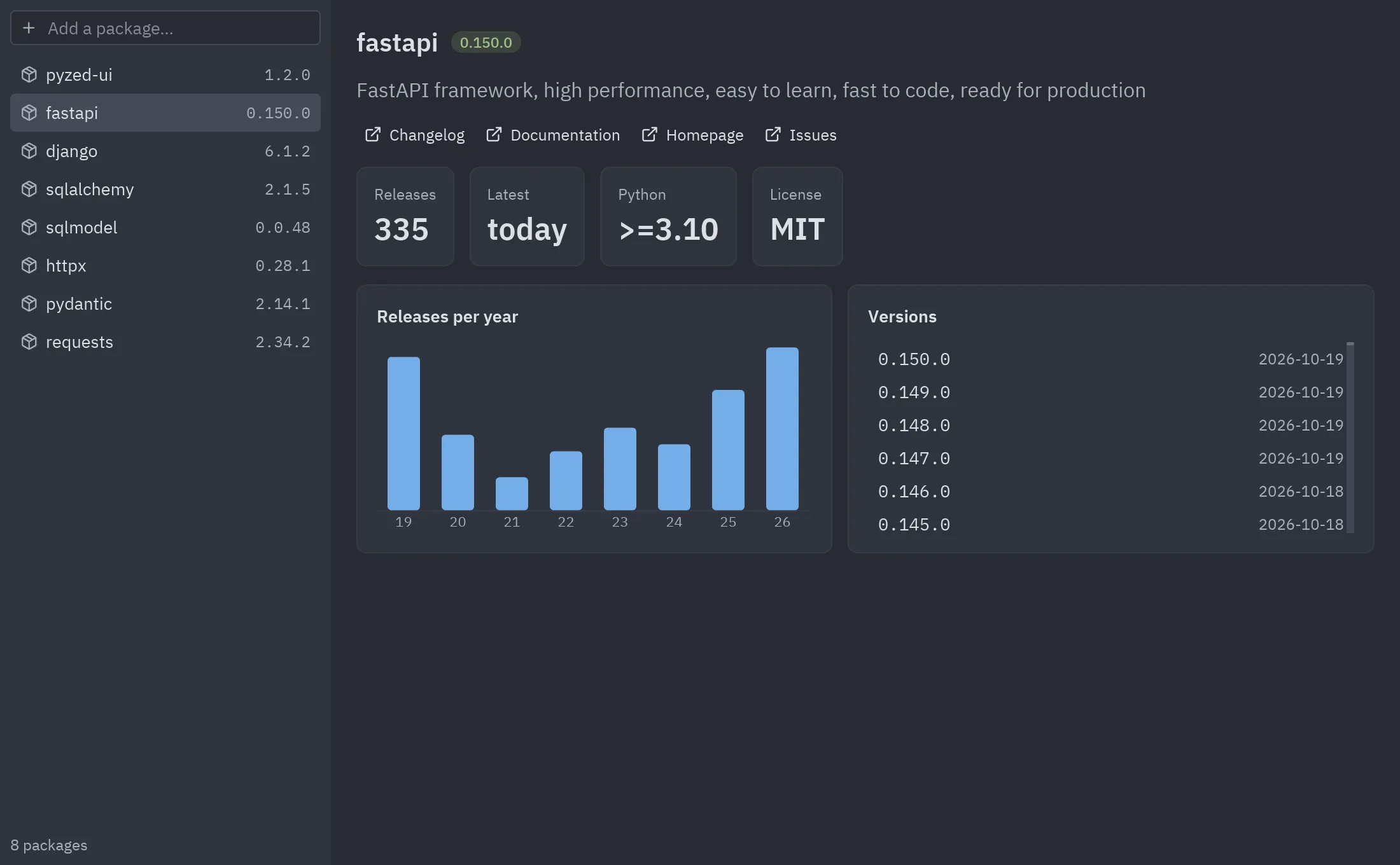
cd examples/integrations/httpx_pypiuv run main.pyuv run main.py rich textual polars # other packagescd examples/integrations/httpx_pypipython3 -m venv .venvsource .venv/bin/activatepip install pyzed-ui httpx pydanticpython main.pypython main.py rich textual polars # other packagescd examples/integrations/httpx_pypipy -m venv .venv.venv\Scripts\Activate.ps1pip install pyzed-ui httpx pydanticpython main.pypython main.py rich textual polars # other packagescd examples/integrations/httpx_pypipython3 -m pip install pyzed-ui httpx pydanticpython3 main.pypython3 main.py rich textual polars # other packagescd examples/integrations/httpx_pypipy -m pip install pyzed-ui httpx pydanticpy main.pypy main.py rich textual polars # other packages-
Return a value for every outcome. The model, or a short text for the list:
async def fetch(client, name):try:response = await client.get(f"https://pypi.org/pypi/{name}/json")except httpx.HTTPError as error:return f"Network error: {error}"if response.status_code == 404:return "Not on PyPI"return Package.model_validate_json(response.content) # see the Pydantic page -
Send the requests at once and yield each answer. An async generator returned from
on_startor a callback sends everyyieldtoupdate, so the list fills in as answers arrive:async def fetch_all(names):async with httpx.AsyncClient(timeout=10, follow_redirects=True) as client:async def one(name):return name, await fetch(client, name)for done in asyncio.as_completed([one(n) for n in names]):yield await doneclass Explorer(pz.App):def on_start(self):return fetch_all(self.names)def update(self, message):name, result = messageself.packages[name] = result
"""A PyPI explorer: concurrent httpx requests streamed into the window, responses validated by Pydantic.
    uv run main.py    uv run main.py rich textual polars      # start with other packages
Walkthrough: https://albakore.github.io/pyzed/integrations/httpx/"""
from __future__ import annotations
import sysimport webbrowserfrom datetime import datetime, timezone
import pyzed as pzfrom pyzed import ui
from pypi import Package, fetch_all
DEFAULT = ["pyzed-ui", "fastapi", "django", "sqlalchemy", "sqlmodel", "httpx", "pydantic", "requests"]

def ago(when: datetime) -> str:    days = (datetime.now(timezone.utc) - when).days    if days < 1:        return "today"    if days < 60:        return f"{days} days ago"    return f"{days // 30} months ago" if days < 730 else f"{days // 365} years ago"

class Explorer(pz.App):    title = "PyPI explorer · httpx + Pydantic"    size = (1100, 680)
    def __init__(self, names: list[str]):        self.names = names        self.packages: dict[str, Package | str | None] = {name: None for name in names}  # None while loading        self.selected = names[0] if names else None        self.new_name = ""
    def on_start(self):        return fetch_all(self.names)  # an async generator: each (name, result) it yields reaches update()
    def update(self, message):        name, result = message        self.packages[name] = result
    def add(self, *_):        name = self.new_name.strip().lower()        self.new_name = ""        if not name:            return None        self.selected = name        if name in self.packages and isinstance(self.packages[name], Package):            return None        self.packages[name] = None        return fetch_all([name])
    # -- view ----------------------------------------------------------------------------    def row(self, name: str):        package = self.packages[name]        if package is None:            end = ui.spinner(size=12)        elif isinstance(package, str):            end = pz.icon("circle-alert", size=14, color=self.resolved_theme().error)        else:            end = ui.muted(package.info.version, size="sm", mono=True)        return ui.list_item(name, lambda: setattr(self, "selected", name), icon="package", end=end,                            selected=name == self.selected, inset=True, height=30)
    def details(self, t):        package = self.packages.get(self.selected)        if package is None:            return pz.center(ui.spinner(size=24))        if isinstance(package, str):            return pz.center(ui.empty_state(self.selected, package, icon="circle-alert"))        info, history = package.info, package.history()        years = package.per_year()        links = [ui.button(label, lambda url=url: webbrowser.open(url), icon="external-link", size="sm", variant="ghost")                 for label, url in list((info.project_urls or {}).items())[:4]]        versions = ui.virtual_list(history, lambda item: pz.row([            ui.label(item[0], mono=True, width="fill"), ui.muted(item[1].strftime("%Y-%m-%d"), size="sm")],            padding=(0, 8), align="center", height=26), item_height=26)        return pz.column([            pz.row([ui.heading(info.name, level=2), ui.badge(info.version, tint="success")], spacing=10, align="center"),            ui.muted(info.summary or "No summary.", size="lg"),            pz.row(links, spacing=4) if links else None,            pz.row([                ui.stat("Releases", len(history)),                ui.stat("Latest", ago(history[0][1]) if history else "—"),                ui.stat("Python", info.requires_python or "any"),                ui.stat("License", (info.license_expression or info.license or "—")[:18]),            ], spacing=12),            pz.row([                ui.card(ui.bar_chart([count for _, count in years], labels=[str(y)[2:] for y, _ in years],                                     width=340, height=150), title="Releases per year", width=374),                ui.card(pz.container(versions, height=150), title="Versions", width="fill"),            ], spacing=12),        ], spacing=14, padding=20)
    def view(self):        t = self.resolved_theme()        loading = sum(p is None for p in self.packages.values())        sidebar = pz.container(pz.column([            ui.input(self.new_name, lambda v: setattr(self, "new_name", v), placeholder="Add a package…",                     icon="plus", on_submit=self.add),            ui.virtual_list(list(self.packages), self.row, item_height=30),            ui.muted(f"Loading {loading}…" if loading else f"{len(self.packages)} packages", size="sm"),        ], spacing=8), padding=8, width=260, height="fill", bg=t.panel)        return pz.row([sidebar, pz.container(self.details(t), width="fill", height="fill", bg=t.editor)])

if __name__ == "__main__":    pz.run(Explorer(sys.argv[1:] or DEFAULT))
"""PyPI's JSON API, described with Pydantic models and fetched with httpx."""
from __future__ import annotations
import asynciofrom collections import Counterfrom datetime import datetimefrom typing import AsyncIterator
import httpxfrom pydantic import BaseModel, ValidationError
class Info(BaseModel): name: str version: str summary: str | None = None license: str | None = None license_expression: str | None = None # newer packages declare an SPDX expression instead requires_python: str | None = None project_urls: dict[str, str] | None = None
class File(BaseModel): upload_time_iso_8601: datetime yanked: bool = False
class Package(BaseModel): """Only the fields the app shows; Pydantic ignores the rest of the response."""
info: Info releases: dict[str, list[File]]
def history(self) -> list[tuple[str, datetime]]: """(version, first upload) for every release with files, newest first.""" dated = [(version, min(f.upload_time_iso_8601 for f in files)) for version, files in self.releases.items() if files] return sorted(dated, key=lambda item: item[1], reverse=True)
def per_year(self, years: int = 8) -> list[tuple[int, int]]: counts = Counter(date.year for _, date in self.history()) last = datetime.now().year return [(year, counts.get(year, 0)) for year in range(last - years + 1, last + 1)]
async def fetch(client: httpx.AsyncClient, name: str) -> Package | str: """The package, or a short message saying why it couldn't be loaded.""" try: response = await client.get(f"https://pypi.org/pypi/{name}/json") except httpx.HTTPError as error: return f"Network error: {error or type(error).__name__}" if response.status_code == 404: return "Not on PyPI" if response.is_error: return f"PyPI answered {response.status_code}" try: return Package.model_validate_json(response.content) except ValidationError as error: return f"Unexpected response: {error.error_count()} problems"
async def fetch_all(names: list[str]) -> AsyncIterator[tuple[str, Package | str]]: """Requests every package at once and yields each one as soon as it arrives.""" async with httpx.AsyncClient(timeout=10, follow_redirects=True) as client: async def one(name): return name, await fetch(client, name)
for done in asyncio.as_completed([one(n) for n in names]): yield await doneStreaming downloads with progress
Section titled “Streaming downloads with progress”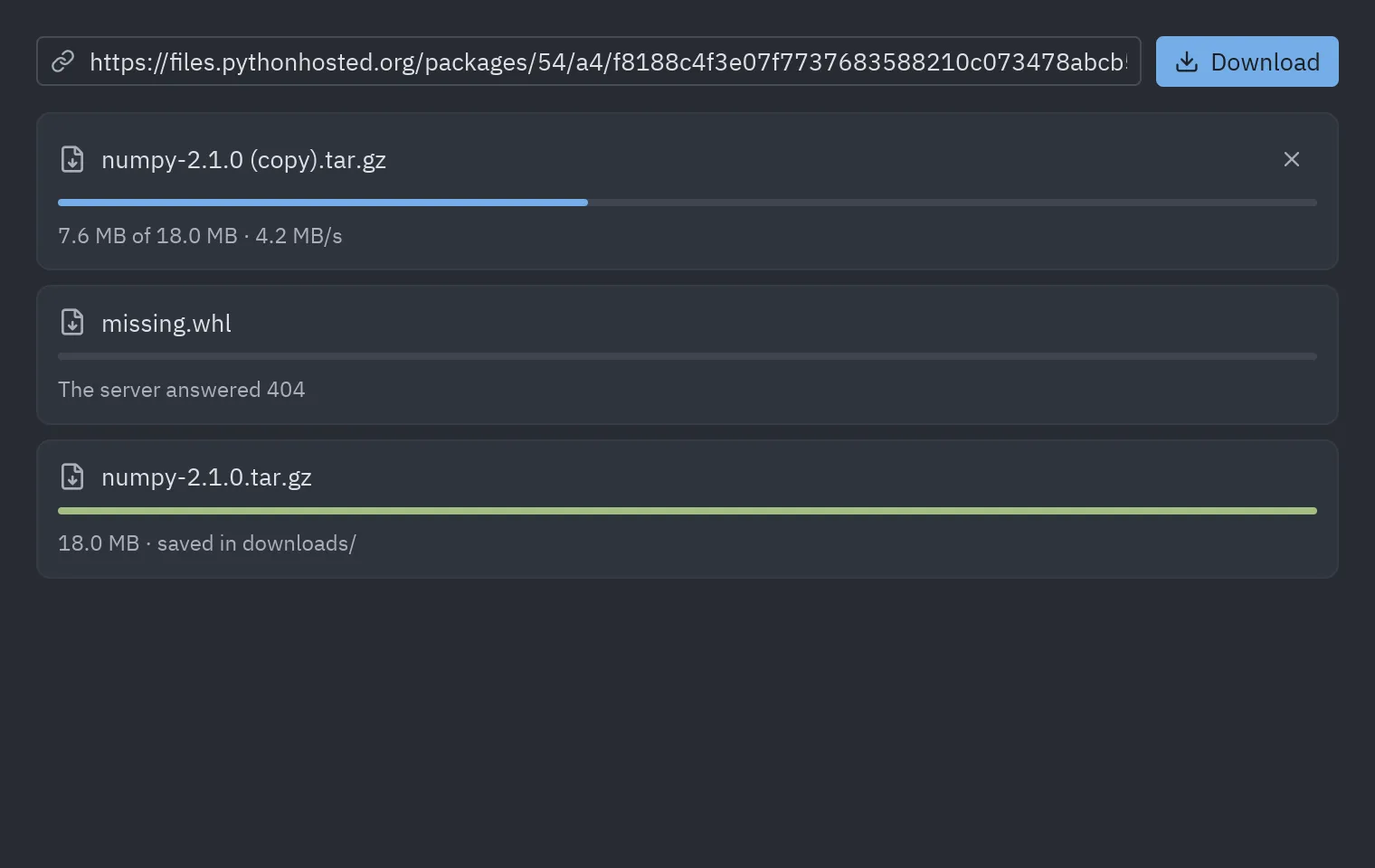
cd examples/integrations/httpx_downloaduv run main.pycd examples/integrations/httpx_downloadpython3 -m venv .venvsource .venv/bin/activatepip install pyzed-ui httpxpython main.pycd examples/integrations/httpx_downloadpy -m venv .venv.venv\Scripts\Activate.ps1pip install pyzed-ui httpxpython main.pycd examples/integrations/httpx_downloadpython3 -m pip install pyzed-ui httpxpython3 main.pycd examples/integrations/httpx_downloadpy -m pip install pyzed-ui httpxpy main.pyhttpx’s streaming responses read
the body in chunks instead of loading it into memory, and its
download progress
recipe uses response.num_bytes_downloaded. In Pyzed the loop becomes an async generator that
yields after every chunk, and the window redraws the bar each time:
async def download(item):    async with httpx.AsyncClient(follow_redirects=True) as client:        async with client.stream("GET", item.url) as response:            response.raise_for_status()            item.total = int(response.headers["Content-Length"])            with open(FOLDER / item.name, "wb") as file:                async for chunk in response.aiter_bytes():                    if item.cancel:          # set by the Cancel button                        break                    file.write(chunk)                    item.done = response.num_bytes_downloaded                    yield item               # reaches update(), which redraws
class Downloads(pz.App):    def start(self, *_):        item = Download(self.url)        self.items.insert(0, item)        return download(item)
    def view(self):        ...        ui.progress(item.done / item.total)
Several downloads can run at the same time: each one is its own generator on the same loop.
"""A download manager built on httpx's streaming responses, with a live progress bar.
    uv run main.py
It follows httpx's "Monitoring download progress" recipe(https://www.python-httpx.org/advanced/clients/#monitoring-download-progress), written with``AsyncClient.stream`` and ``aiter_bytes``. The download is an async generator: every progressreport it yields reaches ``update``, so the window redraws while the bytes arrive.Files are saved in a ``downloads`` folder next to this file.Walkthrough: https://albakore.github.io/pyzed/integrations/httpx/"""
from __future__ import annotations
import timefrom pathlib import Pathfrom urllib.parse import urlsplit
import httpx
import pyzed as pzfrom pyzed import ui
FOLDER = Path(__file__).with_name("downloads")EXAMPLE = ("https://files.pythonhosted.org/packages/54/a4/f8188c4f3e07f7737683588210c073478abcb542048cf4ab6fedad0b458a/"           "numpy-2.1.0.tar.gz")

def size(num_bytes: float) -> str:    for unit in ("B", "KB", "MB", "GB"):        if num_bytes < 1024 or unit == "GB":            return f"{num_bytes:.0f} {unit}" if unit == "B" else f"{num_bytes:.1f} {unit}"        num_bytes /= 1024

class Download:    """One row of the list. ``total`` is None when the server sends no Content-Length."""
    def __init__(self, url: str):        self.url = url        self.name = Path(urlsplit(url).path).name or "download"        self.done, self.total = 0, None        self.speed = 0.0        self.state = "waiting"  # waiting, downloading, finished, cancelled or the error text        self.cancel = False     # set by the Cancel button, read by the loop below

async def download(item: Download):    """Streams ``item.url`` to disk, yielding ``item`` after every chunk."""    FOLDER.mkdir(exist_ok=True)    started = time.monotonic()    try:        async with httpx.AsyncClient(follow_redirects=True, timeout=30) as client:            async with client.stream("GET", item.url) as response:                response.raise_for_status()                length = response.headers.get("Content-Length")                item.total, item.state = (int(length) if length else None), "downloading"                with open(FOLDER / item.name, "wb") as file:                    async for chunk in response.aiter_bytes():                        if item.cancel:                            item.state = "cancelled"                            break                        file.write(chunk)                        item.done = response.num_bytes_downloaded                        item.speed = item.done / max(time.monotonic() - started, 1e-6)                        yield item        if item.state == "downloading":            item.state = "finished"    except httpx.HTTPStatusError as error:        item.state = f"The server answered {error.response.status_code}"    except httpx.HTTPError as error:        item.state = f"{type(error).__name__}: {error}"    yield item

class Downloads(pz.App):    title = "Downloads · httpx"    size = (760, 480)
    def __init__(self):        self.url = EXAMPLE        self.items: list[Download] = []
    def start(self, *_):        url = self.url.strip()        if not url.startswith(("http://", "https://")):            return None        item = Download(url)        self.items.insert(0, item)        return download(item)  # Pyzed runs the generator on its loop and sends each yield to update()
    def update(self, item: Download):        pass  # the Download object was changed in place; returning from update redraws the window
    def row(self, item: Download):        t = self.resolved_theme()        if item.state == "downloading":            detail = f"{size(item.done)} of {size(item.total) if item.total else '?'} · {size(item.speed)}/s"            action = ui.icon_button("x", lambda: setattr(item, "cancel", True), tooltip="Cancel")        elif item.state == "finished":            detail, action = f"{size(item.done)} · saved in downloads/", None        else:            detail, action = item.state.capitalize(), None        failed = item.state not in ("waiting", "downloading", "finished")        value = item.done / item.total if item.total else (1.0 if item.state == "finished" else 0.0)        return ui.card(pz.column([            pz.row([pz.icon("file-down", size=16, color=t.icon_muted), ui.label(item.name, width="fill"), action],                   spacing=8, align="center"),            ui.progress(value, tint="error" if failed else "success" if item.state == "finished" else "accent"),            ui.muted(detail, size="sm"),        ], spacing=8), padding=12)
    def view(self):        t = self.resolved_theme()        body = pz.scrollable(pz.column([self.row(i) for i in self.items], spacing=8), height="fill") if self.items \            else ui.empty_state("No downloads", "Paste a URL and press Download.", icon="download")        return pz.container(pz.column([            pz.row([ui.input(self.url, lambda v: setattr(self, "url", v), icon="link", on_submit=self.start),                    ui.button("Download", self.start, icon="download", variant="solid")], spacing=8),            body,        ], spacing=14), padding=20, width="fill", height="fill", bg=t.editor)

if __name__ == "__main__":    pz.run(Downloads)