
FastAPI
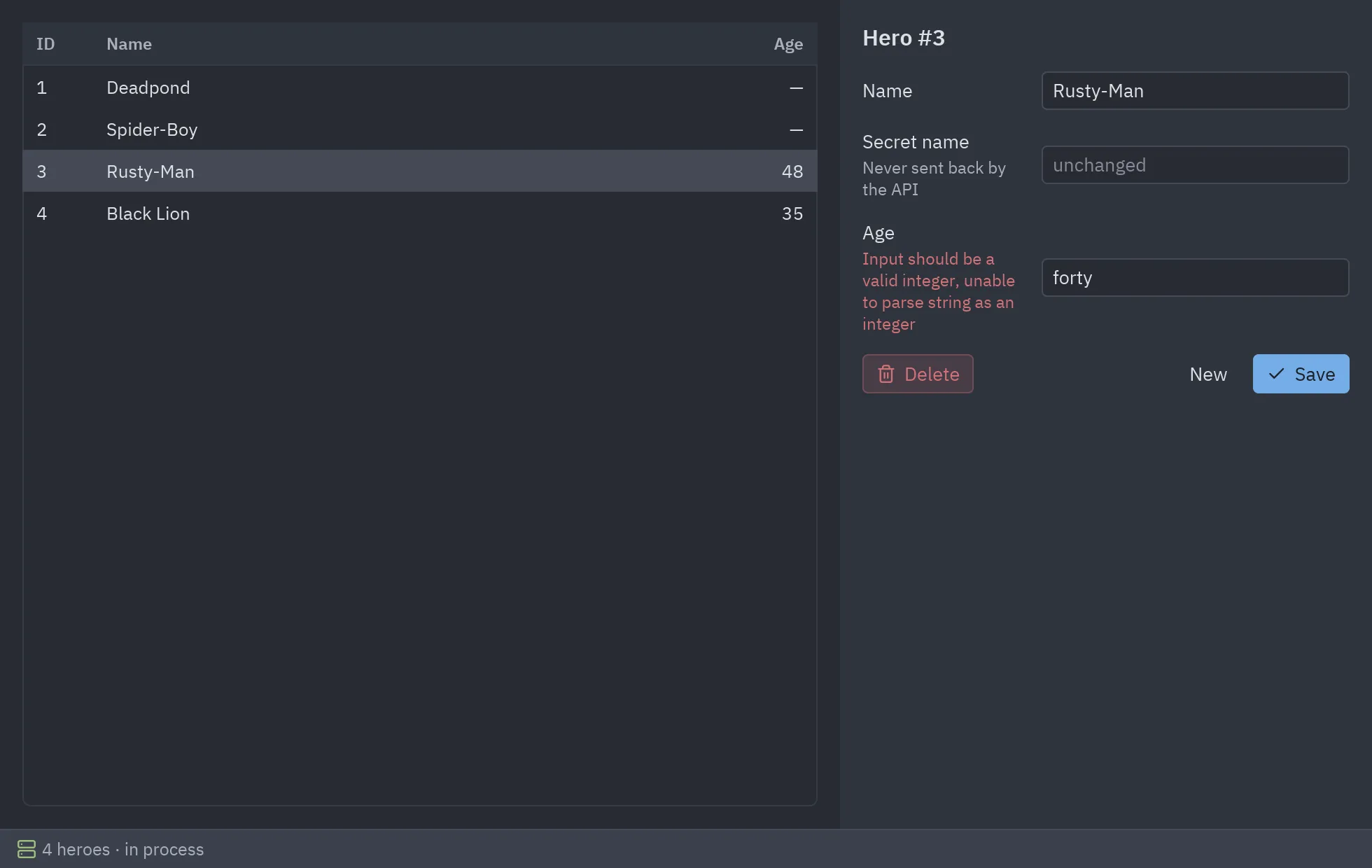
La API de esta demo es el tutorial SQL (Relational) Databases de FastAPI, copiado sin cambios: héroes guardados con SQLModel, con modelos separados para crear, leer y actualizar. La ventana de Pyzed es un cliente de escritorio para ella, y la misma ventana funciona en las tres arquitecturas en las que hay una API.
fastapi_heroes/├── main.py # la API, exactamente como en el tutorial de FastAPI├── heroes_window.py # la ventana de Pyzed, que solo habla HTTP (httpx)├── client.py # 2. cliente y servidor├── embedded.py # 3. servidor integrado└── in_process.py # 4. en el proceso1. La API, como la enseña FastAPI
Sección titulada «1. La API, como la enseña FastAPI»-
Instala FastAPI con sus extras estándar, que traen la CLI
fastapiy Uvicorn. Elpyproject.tomlde la demo ya los incluye:Windows, macOS y Linux cd examples/integrations/fastapi_heroesuv add "fastapi[standard]" sqlmodel httpx # en tu propio proyectomacOS y Linux cd examples/integrations/fastapi_heroespython3 -m venv .venvsource .venv/bin/activatepip install pyzed-ui "fastapi[standard]" sqlmodel httpxWindows (PowerShell) cd examples/integrations/fastapi_heroespy -m venv .venv.venv\Scripts\Activate.ps1pip install pyzed-ui "fastapi[standard]" sqlmodel httpxmacOS y Linux cd examples/integrations/fastapi_heroespython3 -m pip install pyzed-ui "fastapi[standard]" sqlmodel httpxWindows (PowerShell) cd examples/integrations/fastapi_heroespy -m pip install pyzed-ui "fastapi[standard]" sqlmodel httpx -
Escribe los modelos.
HeroBasetiene los campos comunes,Heroes la tabla,HeroPublices lo que devuelve la API (nunca elsecret_name), yHeroCreateyHeroUpdatedescriben los cuerpos de las peticiones:class HeroBase(SQLModel):name: str = Field(index=True)age: int | None = Field(default=None, index=True)class Hero(HeroBase, table=True):id: int | None = Field(default=None, primary_key=True)secret_name: strclass HeroPublic(HeroBase):id: intclass HeroCreate(HeroBase):secret_name: strclass HeroUpdate(HeroBase):name: str | None = Noneage: int | None = Nonesecret_name: str | None = None -
Declara una dependencia de sesión para que cada petición tenga su propia
Session:def get_session():with Session(engine) as session:yield sessionSessionDep = Annotated[Session, Depends(get_session)] -
Escribe las operaciones de ruta.
response_modelfiltra la salida y FastAPI valida la entrada, y responde 422 con una entrada por cada campo inválido:@app.post("/heroes/", response_model=HeroPublic)def create_hero(hero: HeroCreate, session: SessionDep):db_hero = Hero.model_validate(hero)session.add(db_hero)session.commit()session.refresh(db_hero)return db_hero@app.patch("/heroes/{hero_id}", response_model=HeroPublic)def update_hero(hero_id: int, hero: HeroUpdate, session: SessionDep):hero_db = session.get(Hero, hero_id)if not hero_db:raise HTTPException(status_code=404, detail="Hero not found")hero_data = hero.model_dump(exclude_unset=True)hero_db.sqlmodel_update(hero_data)... -
Ejecútala con la CLI de FastAPI y abre la documentación interactiva en http://127.0.0.1:8000/docs:
Windows, macOS y Linux uv run fastapi dev main.pyWindows, macOS y Linux fastapi dev main.pymacOS y Linux python3 -m fastapi dev main.pyWindows (PowerShell) py -m fastapi dev main.pyfastapi devrecarga con cada cambio;fastapi run main.pyes el comando de producción.
El cliente de escritorio
Sección titulada «El cliente de escritorio»heroes_window.py es una pz.App que habla con la API con un httpx.AsyncClient. Recibe una
función que crea el cliente, así que la misma ventana funciona con cualquiera de las
arquitecturas de abajo.
-
Envía las peticiones desde corrutinas. Devolver una corrutina desde un callback la ejecuta en el loop de asyncio de Pyzed, y lo que devuelve llega a
update. El cliente se crea la primera vez que se usa, para que pertenezca a ese loop:async def api(self, method, url, **kwargs):if self.client is None:self.client = self.make_client()try:return await self.client.request(method, url, **kwargs)except httpx.HTTPError as error:return f"Can't reach the API: {error}"async def load(self):response = await self.api("GET", "/heroes/", params={"limit": 100})if isinstance(response, str):return ("offline", response)return ("loaded", response.json()) -
Crea con POST y edita con PATCH. Solo se envían los campos que el usuario rellenó, que es lo que esperan
HeroUpdateyexclude_unset=True:async def save(self):body = {key: value for key, value in self.draft.items() if value != ""}if self.selected is None:response = await self.api("POST", "/heroes/", json=body)else:response = await self.api("PATCH", f"/heroes/{self.selected['id']}", json=body)if response.status_code == 422:return ("invalid", response.json())... -
Muestra el 422 de FastAPI en cada campo.
pz.validation_errorslee{"detail": [...]}y devuelve{"age": "Input should be a valid integer, ..."}:def update(self, message):kind, value = messageif kind == "invalid":self.errors = pz.validation_errors(value)
2. Cliente y servidor
Sección titulada «2. Cliente y servidor»La API y la ventana son dos programas. Así se usa una API desplegada, y así trabajas en las dos a la vez con recarga:
uv run fastapi dev main.py # terminal 1uv run client.py # terminal 2 (o: uv run client.py https://api.example.com)fastapi dev main.py # terminal 1python client.py # terminal 2 (o: python client.py https://api.example.com)python3 -m fastapi dev main.py # terminal 1python3 client.py # terminal 2 (o: python3 client.py https://api.example.com)py -m fastapi dev main.py # terminal 1py client.py # terminal 2 (o: py client.py https://api.example.com)"""Architecture 1, client and server: the API runs on its own and the window talks to it over HTTP.
uv run fastapi dev main.py # terminal 1: the API (FastAPI's own CLI) uv run client.py # terminal 2: the desktop client uv run client.py https://api.example.com # or any other deployment of main.py
The usual setup when the API also serves a website or a mobile app, or runs on a server."""
import sys
import httpx
import pyzed as pz
from heroes_window import HeroesWindow
API = sys.argv[1] if len(sys.argv) > 1 else "http://127.0.0.1:8000"
if __name__ == "__main__": pz.run(HeroesWindow(lambda: httpx.AsyncClient(base_url=API, timeout=5), mode=f"server at {API}", docs_url=f"{API}/docs"))3. Servidor integrado
Sección titulada «3. Servidor integrado»Un solo comando arranca la API en un hilo en segundo plano con Uvicorn, el servidor que usa
fastapi run, y abre la ventana. Mientras la ventana está abierta,
http://127.0.0.1:8000/docs también funciona en un navegador.
uv run embedded.pypython embedded.pypython3 embedded.pypy embedded.py"""Architecture 2, embedded server: one program starts the API and opens the window.
uv run embedded.py
The API runs with Uvicorn (the server `fastapi run` and `fastapi dev` use) in a backgroundthread, so other programs on this computer, a browser at /docs for instance, can use itwhile the window is open. It stops when the window closes."""
import threading
import httpximport uvicorn
import pyzed as pz
from heroes_window import HeroesWindowfrom main import app
HOST, PORT = "127.0.0.1", 8000
def start_api() -> None: # What `fastapi run main.py` does, but in a thread of this process. server = uvicorn.Server(uvicorn.Config(app, host=HOST, port=PORT, log_level="warning")) threading.Thread(target=server.run, daemon=True).start()
if __name__ == "__main__": start_api() url = f"http://{HOST}:{PORT}" pz.run(HeroesWindow(lambda: httpx.AsyncClient(base_url=url, timeout=5), mode=f"embedded at {url}", docs_url=f"{url}/docs"))4. En el proceso
Sección titulada «4. En el proceso»Sin servidor y sin puerto: httpx.ASGITransport entrega cada petición a la app de FastAPI como
una llamada a función. El programa funciona sin conexión, y el código de la API no cambia.
uv run in_process.pypython in_process.pypython3 in_process.pypy in_process.py"""Architecture 3, in process: the window calls the FastAPI app directly, with no server or port.
uv run in_process.py
httpx can send requests straight to an ASGI app (httpx.ASGITransport), so the same API codeand the same client code run inside one desktop program that works offline. Nothing listenson the network. ASGITransport doesn't send startup events, so the tables are created here."""
import httpx
import pyzed as pz
from heroes_window import HeroesWindowfrom main import app, create_db_and_tables
if __name__ == "__main__": create_db_and_tables() transport = httpx.ASGITransport(app=app) pz.run(HeroesWindow(lambda: httpx.AsyncClient(transport=transport, base_url="http://heroes"), mode="in process"))Código completo
Sección titulada «Código completo»"""The FastAPI app, exactly as FastAPI's "SQL (Relational) Databases" tutorial writes it:https://fastapi.tiangolo.com/tutorial/sql-databases/
uv run fastapi dev main.py # http://127.0.0.1:8000, interactive docs at /docs
Nothing in this file knows about Pyzed. The three desktop entry points (client.py,embedded.py, in_process.py) reuse it unchanged."""
from typing import Annotated
from fastapi import Depends, FastAPI, HTTPException, Queryfrom sqlmodel import Field, Session, SQLModel, create_engine, select
class HeroBase(SQLModel):    name: str = Field(index=True)    age: int | None = Field(default=None, index=True)
class Hero(HeroBase, table=True):    id: int | None = Field(default=None, primary_key=True)    secret_name: str
class HeroPublic(HeroBase):    id: int
class HeroCreate(HeroBase):    secret_name: str
class HeroUpdate(HeroBase):    name: str | None = None    age: int | None = None    secret_name: str | None = None
sqlite_file_name = "database.db"sqlite_url = f"sqlite:///{sqlite_file_name}"
connect_args = {"check_same_thread": False}engine = create_engine(sqlite_url, connect_args=connect_args)
def create_db_and_tables(): SQLModel.metadata.create_all(engine)
def get_session():    with Session(engine) as session:        yield session
SessionDep = Annotated[Session, Depends(get_session)]app = FastAPI()
@app.on_event("startup")def on_startup(): create_db_and_tables()
@app.post("/heroes/", response_model=HeroPublic)def create_hero(hero: HeroCreate, session: SessionDep): db_hero = Hero.model_validate(hero) session.add(db_hero) session.commit() session.refresh(db_hero) return db_hero
@app.get("/heroes/", response_model=list[HeroPublic])def read_heroes( session: SessionDep, offset: int = 0, limit: Annotated[int, Query(le=100)] = 100,): heroes = session.exec(select(Hero).offset(offset).limit(limit)).all() return heroes
@app.get("/heroes/{hero_id}", response_model=HeroPublic)def read_hero(hero_id: int, session: SessionDep): hero = session.get(Hero, hero_id) if not hero: raise HTTPException(status_code=404, detail="Hero not found") return hero
@app.patch("/heroes/{hero_id}", response_model=HeroPublic)def update_hero(hero_id: int, hero: HeroUpdate, session: SessionDep): hero_db = session.get(Hero, hero_id) if not hero_db: raise HTTPException(status_code=404, detail="Hero not found") hero_data = hero.model_dump(exclude_unset=True) hero_db.sqlmodel_update(hero_data) session.add(hero_db) session.commit() session.refresh(hero_db) return hero_db
@app.delete("/heroes/{hero_id}")def delete_hero(hero_id: int, session: SessionDep): hero = session.get(Hero, hero_id) if not hero: raise HTTPException(status_code=404, detail="Hero not found") session.delete(hero) session.commit() return {"ok": True}"""The Pyzed window: a desktop client for the heroes API in main.py, written with httpx.
It only knows the API's URLs and JSON, so it works the same whether the API runs in anotherprocess, in a thread of this one or in-process without a network (see client.py,embedded.py and in_process.py)."""
from __future__ import annotations
import webbrowserfrom typing import Callable
import httpx
import pyzed as pzfrom pyzed import ui
EMPTY = {"name": "", "secret_name": "", "age": ""}
class HeroesWindow(pz.App): title = "Heroes · FastAPI" size = (980, 620)
def __init__(self, make_client: Callable[[], httpx.AsyncClient], mode: str, docs_url: str | None = None): self.make_client = make_client # called once, inside a coroutine, so the client lives on Pyzed's loop self.client: httpx.AsyncClient | None = None self.mode, self.docs_url = mode, docs_url self.heroes: list[dict] = [] self.selected: dict | None = None # the hero being edited, or None for a new one self.draft = dict(EMPTY) self.errors: dict[str, str] = {} self.status = "Connecting…"
# -- the API, with httpx -------------------------------------------------------------- async def api(self, method: str, url: str, **kwargs) -> httpx.Response | str: """Sends a request; returns the response, or the error text when the API can't be reached.""" if self.client is None: self.client = self.make_client() try: return await self.client.request(method, url, **kwargs) except httpx.HTTPError as error: return f"Can't reach the API: {error or type(error).__name__}"
async def load(self): response = await self.api("GET", "/heroes/", params={"limit": 100}) # GET /heroes/?offset=0&limit=100 if isinstance(response, str): return ("offline", response) return ("loaded", response.json())
async def save(self): body = {key: value for key, value in self.draft.items() if value != ""} # leave empty fields out if self.selected is None: response = await self.api("POST", "/heroes/", json=body) else: response = await self.api("PATCH", f"/heroes/{self.selected['id']}", json=body) if isinstance(response, str): return ("offline", response) if response.status_code == 422: # FastAPI's validation error, one entry per field return ("invalid", response.json()) response.raise_for_status() return ("saved", response.json())
async def delete(self): response = await self.api("DELETE", f"/heroes/{self.selected['id']}") if isinstance(response, str): return ("offline", response) return ("deleted", self.selected["id"])
# -- state ----------------------------------------------------------------------------- def on_start(self): return self.load()
def pick(self, hero: dict | None): self.selected, self.errors = hero, {} self.draft = dict(EMPTY) if hero is None else { "name": hero["name"], "secret_name": "", "age": "" if hero["age"] is None else str(hero["age"])}
def edit(self, key: str): return lambda value: self.draft.__setitem__(key, value)
def update(self, message): kind, value = message if kind == "loaded": self.heroes, self.status = value, f"{len(value)} heroes · {self.mode}" elif kind == "offline": self.status = value elif kind == "invalid": self.errors = pz.validation_errors(value) elif kind == "saved": self.pick(value) return self.load() elif kind == "deleted": self.pick(None) return self.load()
# -- view -------------------------------------------------------------------------------- def form(self): e = self.errors.get new = self.selected is None return pz.column([ ui.heading("New hero" if new else f"Hero #{self.selected['id']}", level=3), ui.field("Name", ui.input(self.draft["name"], self.edit("name"), placeholder="Deadpond", width=220), error=e("name")), ui.field("Secret name", ui.input(self.draft["secret_name"], self.edit("secret_name"), placeholder="Dive Wilson" if new else "unchanged", width=220), description="Never sent back by the API", error=e("secret_name")), ui.field("Age", ui.input(self.draft["age"], self.edit("age"), placeholder="optional", width=220), error=e("age")), pz.row([ None if new else ui.button("Delete", self.delete, icon="trash-2", variant="ghost", tint="error"), pz.hspace(), ui.button("New", lambda: self.pick(None), variant="ghost") if not new else None, ui.button("Create" if new else "Save", self.save, icon="check", variant="solid"), ], spacing=8), ], spacing=14, padding=16, width=380)
def view(self): t = self.resolved_theme() columns = [ui.Column("ID", "id", width=50), ui.Column("Name", "name"), ui.Column("Age", lambda h: "—" if h["age"] is None else h["age"], width=70, align="end")] table = ui.table(columns, self.heroes, on_row_press=self.pick, selected=self.selected, height="fill") offline = self.status.startswith("Can't") status = ui.status_bar( [ui.status_item(self.status, icon="cloud-off" if offline else "server", icon_color="error" if offline else "success")], [ui.status_item("API docs", lambda: webbrowser.open(self.docs_url), icon="book-open")] if self.docs_url else [], ) body = pz.row([pz.container(table, padding=16, width="fill", height="fill"), pz.container(self.form(), height="fill", bg=t.panel)]) return pz.container(pz.column([body, status]), width="fill", height="fill", bg=t.editor)