
Asistente de bienvenida
Un asistente de cuatro pasos: indicador de pasos vertical con progreso, formulario de perfil, nombre del espacio con tarjetas de plantilla seleccionables, invitaciones al equipo y un resumen antes de empezar. Cada paso valida antes de seguir.
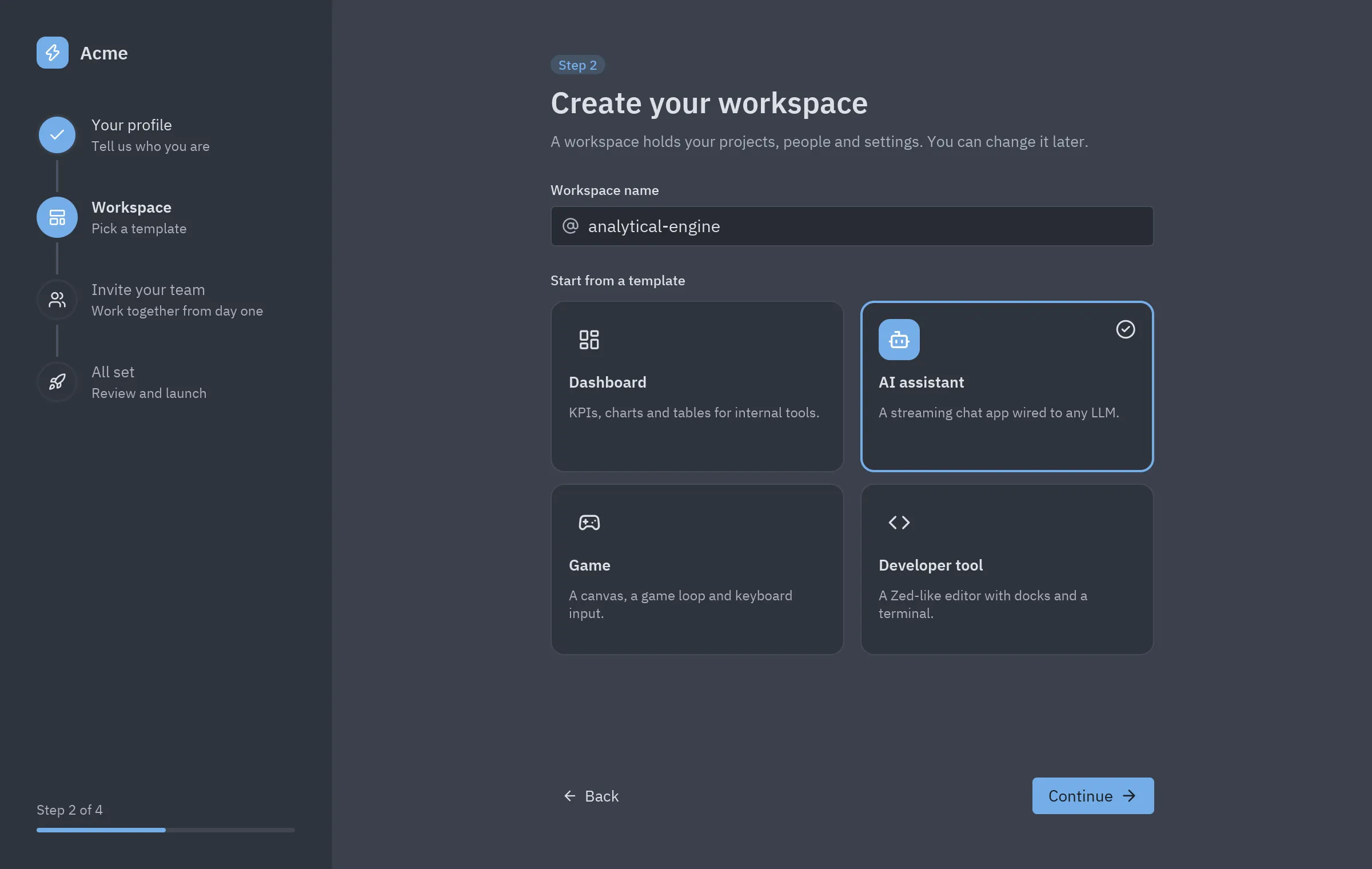
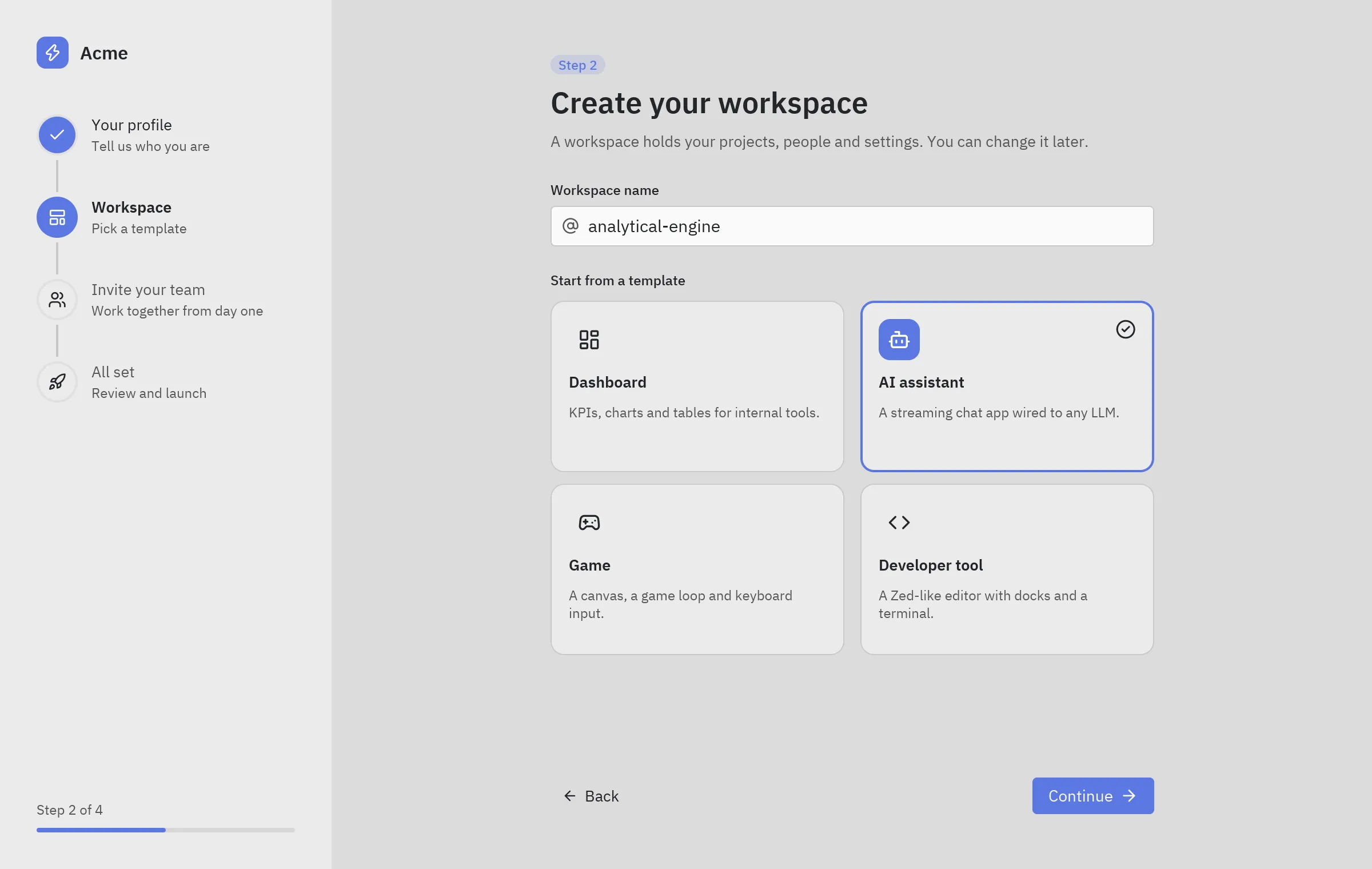
La captura sigue el tema del sitio: cambia entre claro y oscuro arriba de la página para ver el bloque en One Light y One Dark.
Ejecutarlo
Sección titulada «Ejecutarlo»Desde la raíz del repositorio:
python examples/blocks/onboarding.pyQué muestra
Sección titulada «Qué muestra»- El paso actual es estado simple (
self.step); cada paso es un método que devuelve su vista. - Tarjetas seleccionables con
pz.container(...).style(...).on(click=...). - El indicador de pasos usa iconos,
pz.ruley tokens del tema, así sigue cualquier tema. - Botones Atrás / Continuar / Omitir y un aviso de error.
Componentes que usa
Sección titulada «Componentes que usa»| Componente | Para |
|---|---|
| Progress | Progreso total |
| Input | Campos de texto |
| Select | Rol |
| Badge | Número de paso |
| Card | Invitaciones y resumen |
| List item | Personas invitadas |
| Empty state | Sin invitaciones |
| Callout | Errores de validación |
| Button | Navegación |
El bloque completo, listo para copiar. Solo necesita pip install pyzed-ui.
"""Onboarding block: a multi-step setup wizard with a stepper, choice cards, validation and a summary."""
import pyzed as pzfrom pyzed import ui
STEPS = [    ("user", "Your profile", "Tell us who you are"),    ("layout-template", "Workspace", "Pick a template"),    ("users", "Invite your team", "Work together from day one"),    ("rocket", "All set", "Review and launch"),]TEMPLATES = [    ("layout-dashboard", "Dashboard", "KPIs, charts and tables for internal tools."),    ("bot", "AI assistant", "A streaming chat app wired to any LLM."),    ("gamepad-2", "Game", "A canvas, a game loop and keyboard input."),    ("code", "Developer tool", "A code editor with docks and a terminal."),]ROLES = ["Developer", "Designer", "Data scientist", "Student", "Founder"]

class Onboarding(pz.App):    title = "Welcome"    size = (1200, 760)
    def __init__(self):        self.step = 1        self.name = "Ada Lovelace"        self.role = "Developer"        self.template = "AI assistant"        self.workspace = "analytical-engine"        self.invites = ["charles@babbage.dev"]        self.invite = ""        self.error = ""
    # -- actions ---------------------------------------------------------------------------    def next(self):        if self.step == 0 and not self.name.strip():            self.error = "Please enter your name."            return        if self.step == 1 and not self.workspace.strip():            self.error = "Your workspace needs a name."            return        self.error = ""        self.step = min(self.step + 1, len(STEPS) - 1)
    def back(self):        self.error, self.step = "", max(self.step - 1, 0)
    def add_invite(self):        if "@" in self.invite and self.invite not in self.invites:            self.invites.append(self.invite.strip())            self.invite = ""
    # -- pieces ----------------------------------------------------------------------------    def stepper(self):        items = []        for i, (icon, title, subtitle) in enumerate(STEPS):            done, current = i < self.step, i == self.step            marker = pz.container(                pz.icon("check" if done else icon, size=16, color="#ffffff" if done or current else None),                width=36, height=36, center=True,            ).style(background="accent" if done or current else "element", radius=18,                    border=(2, "accent" if current else "border_variant"))            items.append(pz.row([                marker,                pz.column([ui.label(title, weight="semibold" if current else None,                                    color="text" if done or current else "text_muted"),                           ui.muted(subtitle, size="sm")], spacing=2),            ], spacing=12, align="center"))            if i < len(STEPS) - 1:                items.append(pz.container(pz.rule(vertical=True, thickness=2), height=28, padding=(0, 0, 0, 17)))        return pz.column([            pz.row([pz.container(pz.icon("zap", size=16, color="#ffffff"), padding=6).style(                        background="accent", radius=8),                    ui.label("Acme", size="lg", weight="semibold")], spacing=10, align="center"),            pz.space(height=24),            pz.column(items, spacing=4),            pz.vspace(),            ui.muted("Step {} of {}".format(self.step + 1, len(STEPS)), size="sm"),            ui.progress(self.step + 1, max=len(STEPS), height=4),        ], spacing=8, width=290, height="fill", padding=32).style(background="panel")
    def template_card(self, icon, title, text):        selected = title == self.template        return pz.container(            pz.column([                pz.row([pz.container(pz.icon(icon, size=20), padding=8).style(                            background="accent" if selected else "element", radius=10,                            color="#ffffff" if selected else "text"),                        pz.hspace(),                        pz.icon("circle-check", size=18) if selected else None], align="start"),                ui.label(title, weight="semibold"),                ui.muted(text, size="sm"),            ], spacing=10),            padding=16, width="fill", height=150,        ).style(background="surface", radius=12, border=(2 if selected else 1, "accent" if selected else "border"),                ).on(click=lambda: setattr(self, "template", title), cursor="pointer")
    def profile_step(self):        return pz.column([            ui.field("Full name", pz.container(ui.input(self.name, lambda v: setattr(self, "name", v)), width=340)),            ui.field("What do you do?", ui.select(ROLES, self.role, lambda v: setattr(self, "role", v), width=340)),        ], spacing=16)
    def workspace_step(self):        cards = [self.template_card(*t) for t in TEMPLATES]        return pz.column([            pz.column([ui.label("Workspace name", size="sm", weight="medium"),                       ui.input(self.workspace, lambda v: setattr(self, "workspace", v), icon="at-sign",                                size="lg")], spacing=6),            pz.column([ui.label("Start from a template", size="sm", weight="medium"),                       pz.row(cards[:2], spacing=14), pz.row(cards[2:], spacing=14)], spacing=10),        ], spacing=22)
    def team_step(self):        people = [ui.list_item(email, None, icon="mail", end=ui.icon_button(            "x", lambda email=email: self.invites.remove(email), size="sm")) for email in self.invites]        return pz.column([            pz.row([ui.input(self.invite, lambda v: setattr(self, "invite", v), placeholder="teammate@company.com",                             icon="mail", on_submit=self.add_invite, size="lg"),                    ui.button("Add", self.add_invite, size="lg")], spacing=8),            ui.card(pz.column(people, spacing=2) if people else ui.empty_state("No invites yet", icon="users"),                    padding=6),        ], spacing=14)
    def summary_step(self):        rows = [("Name", self.name), ("Role", self.role), ("Workspace", f"@{self.workspace}"),                ("Template", self.template), ("Invites", str(len(self.invites)))]        return ui.card(pz.column([pz.row([ui.muted(k), pz.hspace(), ui.label(v, weight="medium")]) for k, v in rows],                                 spacing=12))
    def view(self):        icon, title, subtitle = STEPS[self.step]        body = [self.profile_step, self.workspace_step, self.team_step, self.summary_step][self.step]()        last = self.step == len(STEPS) - 1        content = pz.column([            pz.column([ui.badge(f"Step {self.step + 1}", tint="accent"),                       ui.heading(["Nice to meet you", "Create your workspace", "Bring your team",                                   "You're ready to go"][self.step]),                       ui.muted(["We'll tailor Acme to how you work.",                                 "A workspace holds your projects, people and settings. You can change it later.",                                 "Invite people now or skip this step; they'll get an email.",                                 "Here's what we'll set up for you."][self.step])], spacing=8),            body,            ui.callout(self.error, tint="error", icon="circle-alert") if self.error else None,            pz.vspace(),            pz.row([                ui.button("Back", self.back, icon="arrow-left", variant="ghost", disabled=self.step == 0),                pz.hspace(),                ui.button("Skip", self.next, variant="ghost") if self.step == 2 else None,                ui.button("Launch workspace" if last else "Continue", self.next, variant="solid", size="lg",                          icon="rocket" if last else "arrow-right", icon_position="start" if last else "end"),            ], spacing=8, align="center"),        ], spacing=26, max_width=640, height="fill", padding=(48, 56))        return pz.row([self.stepper(), ui.divider(vertical=True),                       pz.container(content, width="fill", height="fill", align_x="center")],                      height="fill").style(background="background")

if __name__ == "__main__":    pz.run(Onboarding)
Hazlo tuyo
Sección titulada «Hazlo tuyo»Cambia theme (o self.theme = pz.themes.get("One Dark").with_accent("#e11d48")), pon tus datos en lugar de los de ejemplo y separa piezas en componentes cuando crezcan. Un agente de IA con el servidor MCP puede leer este bloque con read_example("blocks/onboarding") y adaptarlo por ti.